Throughout the history of electronic dance music, there were countless tracks that have drawn on religious themes. Whether that’s mentions of God, the devil, of how music is one’s true religion, all of them together or something in between, I am sure that just by reading these first few lines you may have already thought of a track that fits this description.
The Hard Dance scene, in particular, is rich with such references. We have tracks about music being our only God and Hardstyle being our religion, about God’s plan, some others thanking God for music itself, others celebrating this music as our church… And there’s also the countless references to the Walibi being the holy grounds of Hard Dance, given it’s status as the venue for Defqon.1 for many, many years (and many more to come). There are also some tracks that loosely hover over topics related to religion, and some discussing the devil, terror and lots of unholy themes. Despite the variation, one thing is clear: spirituality is a recurring topic in the music we listen to.
Have you ever stopped to think why?
EDM has historically been misunderstood as a fairly unholy thing in general. Unfortunately, mainstream media and the general public unacknowledgedly portrayed this community as a complete drug and alcohol fueled debauchery taking place while “normal” people sleep. This oversimplified narrative fails to capture the essence of what draws people to EDM. For most true fans, it’s not about excess but about the music, the freedom it brings, and the sense of unity on the dancefloor. Feeling the bass reverberate through your body in a room full of strangers who feel like family is a transcendent experience. It’s a warm feeling of being alone, but definitely not by ourselves.
We also strive for equality on the dancefloor, and acceptance. We want the dancefloor to be a friendly environment. Some even abide the “PLUR” principle, especially North American fans where this sub-culture developed. Peace, Love, Unity and Respect is their motto, and they have a very special way of portraying it… Nevertheless, I think everyone else worldwide can stand behind this motto in a way or another.
We, as Hardstyle fans, go into a pilgrimage every year into the holy grounds that we call home… You’ve heard this countless times on marketing materials for Defqon.1.
And what do we actually do when we arrive there, or at any other event? We go there to gather and express our love for music. Just as the faithful gather at places of worship to strengthen their connection to their beliefs, ravers come together to celebrate their shared love for music. These events are more than parties. They’re spaces for catharsis, connection, and renewal. Attendees shed their burdens – stress, worries, and anxieties – and immerse themselves in a collective spiritual experience.
Isn’t this remarkably similar to religious gatherings? Don’t the faithful also express their devotion and elevate their spirits through music?
I find the similarities uncanny. I have a fairly big religious and spiritual background in my family, and I’ve been raised on an environment where pretty much everyone had a faith of their own, and were active participants in their cities’ religious communities. This background gives me a unique perspective on the intersection of religion and music. While I’m not claiming to be an expert on either, my experiences allow me to see striking parallels.
People go to church to essentially renew the continued connection to their faith. In religion, rituals like communion serve as a means to renew one’s connection to faith. In the world of EDM, the act of gathering on the dancefloor fulfills a similar purpose – a renewal of our bond with the music we love and the community it fosters.
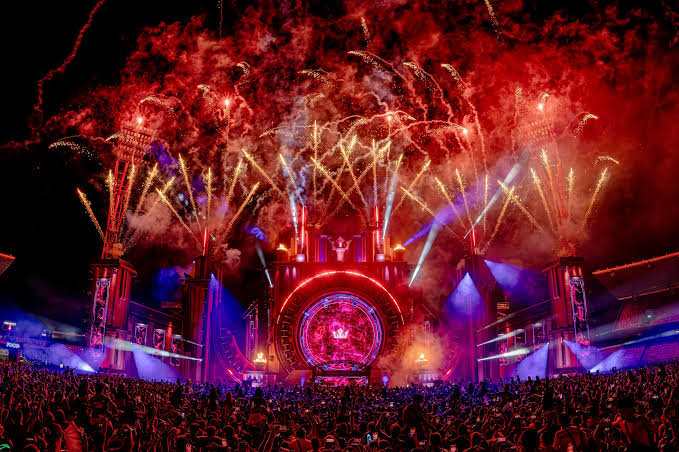
In my country, there’s a place of worldwide pilgrimage for Catholics, which is a big sanctuary in Fátima. People from all over the world go there yearly to participate in ceremonies. Much like dozens of thousands travel from everywhere to Biddinghuizen, to be on the holy grounds of Hard Dance, at the Walibi, for Defqon.1…
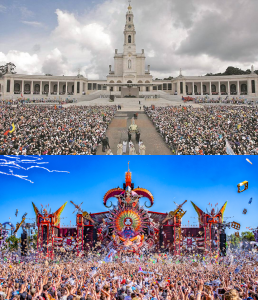
To me, the parallelism is there, and is fairly obvious. A side note for all of this: While my comparisons lean heavily on Catholicism, the same applies to many other religions. This is simply the one I’m most familiarized with. All religions have the same goal, they just get to them through different means. I must also add something slightly off topic, but important to mention: all religions are inherently peaceful, unlike what many people say online, and any actions contradicting this principle are distortions by misguided individuals.
With all this being said, for me, my spiritual side and my identity as a ‘raver’ are deeply interconnected. Each complements the other, creating a balance that enriches my life. My ‘raver’ side carries a spiritual component – music transports me to a higher plane of existence. Conversely, my religious side finds profound expression through music, which acts as a bridge to something greater than myself.
These two aspects of my life are inseparably intertwined in ways that are difficult to articulate, yet unmistakable when felt.