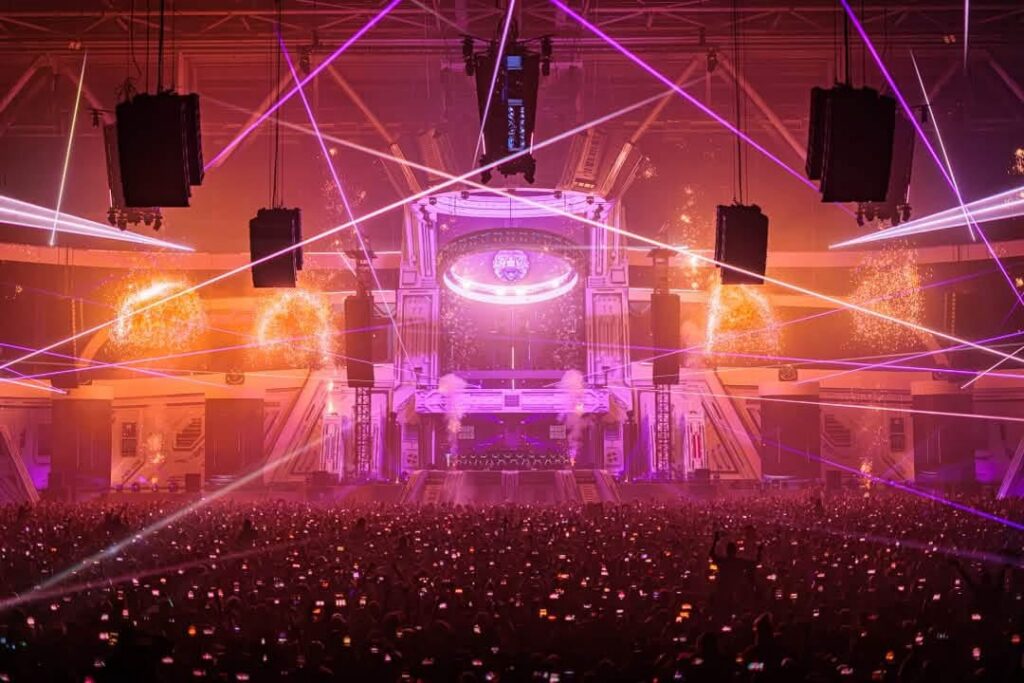
Hard Bass has recently made a successful return. The iconic Hardstyle event came back for one night only after B2S retired the concept in 2019. The organiser promised a night reminiscent of the old days, at the very same venue that helped make the event a phenomenon in the scene, the GelreDome, while keeping an eye on the future of the harder styles.
Judging by the feedback shared online by attendees, B2S largely delivered on that promise. The familiar four-team format returned, with musical intensity gradually increasing from more melodic Hardstyle towards darker and rawer sounds as the night unfolded. Every artist on the line-up had played Hard Bass before, bringing both old favourites and newer music to the table.
However, amidst the largely positive feedback, some recurring criticisms caught my attention. Not necessarily because of what went wrong, but because of what they might tell us about how much Hardstyle has changed since Hard Bass last took place.
Several attendees pointed out that the musical progression throughout the night wasn’t always as smooth as it used to be, with Team Yellow, featuring D-Block & S-te-Fan, Rebelion and Sub Zero Project, attracting particular criticism. Interestingly, all three acts have explored both melodic and raw sounds throughout their discographies (even if D-Block & S-te-Fan lean considerably more towards the melodic side). Yet their approaches to Hardstyle can be vastly different, and bringing those sounds together into one coherent set isn’t necessarily straightforward. While some attendees felt the resulting contrasts disrupted the flow, others enjoyed that very same variety.
Of course, there’s an important distinction here: musical diversity doesn’t automatically make for a coherent DJ set, nor does it excuse poor transitions. But it does make the old progression from melodic to raw considerably trickier to reproduce.
Hardstyle hasn’t simply become harder over the years. It has become a much broader genre, incorporating influences from other genres and allowing artists to explore very different musical directions while still remaining recognisably Hardstyle. What was once a relatively straightforward progression from euphoric to raw has become a much more diverse musical landscape.
And I don’t necessarily see that as a bad thing. Not every sound will appeal to everyone, but there’s something genuinely positive about a genre that can accommodate so many different tastes. It gives artists more freedom to experiment and listeners more ways to enjoy the music.
Perhaps that’s what makes the return of Hard Bass so interesting. For one night, all these different interpretations of Hardstyle came together under the same roof. The musical journey might no longer be as straightforward as it once was, and not every combination will work perfectly, but that doesn’t mean the scene is worse off for it.
If anything, I think Hard Bass reminded us that we don’t all need to enjoy the same kicks, melodies or arrangements to share a love for Hardstyle. And as the genre continues evolving in different directions, I hope that’s something we never lose.